How to Choose the Right Side Hustle for Your Time, Energy and Budget
Choosing a side hustle can feel strangely overwhelming.
Not because there are no options, but because there are too many.
One person says you should start a blog. Someone else says Etsy digital products are the answer. Then you see someone talking about affiliate marketing, Pinterest, Canva templates, AI tools, printables, YouTube, freelancing, digital planners, niche websites, and suddenly your “simple side hustle idea” has turned into a full mental spreadsheet.
If you are already busy, tired, sensitive, introverted, parenting, working, recovering from burnout, or simply trying to make extra money without adding more pressure to your life, that can feel like too much.
The good news is that choosing the right side hustle does not have to start with the most profitable-looking idea.
It should start with your real life.
Your time. Your energy. Your budget. Your skills. Your season. Your capacity.
At Cozy Side Hustle Lab, we believe a calm side hustle should support your life, not consume it. You do not need a loud personal brand, endless motivation, or a perfect plan to begin. You need one realistic idea that fits where you are right now.
This guide will help you choose a side hustle that feels practical, beginner-friendly, and doable — without chasing every shiny idea at once.
What Does It Mean to Choose the Right Side Hustle?
Choosing the right side hustle means choosing an income idea that fits your current time, energy, budget, skills, and personality.
It is not just about asking, “Can this make money?”
A better question is:
“Can I realistically build this with the life I have right now?”
For example, starting a YouTube channel might be a great side hustle for someone who enjoys being on camera, has time to film, and likes learning video editing.
But for someone who feels drained by visibility, has only two hours per week, and wants something quiet, blogging, Pinterest, printables, or affiliate content may be a better fit.
A side hustle can be good and still not be right for you right now.
That is an important distinction.
The right side hustle should feel like a stretch, but not like a complete life takeover. It should help you grow, learn, and earn without becoming another source of constant stress.
This can be simple at the beginning.
You might start with one printable, one blog post, one service offer, one Pinterest account, one Etsy listing, or one small digital product idea.
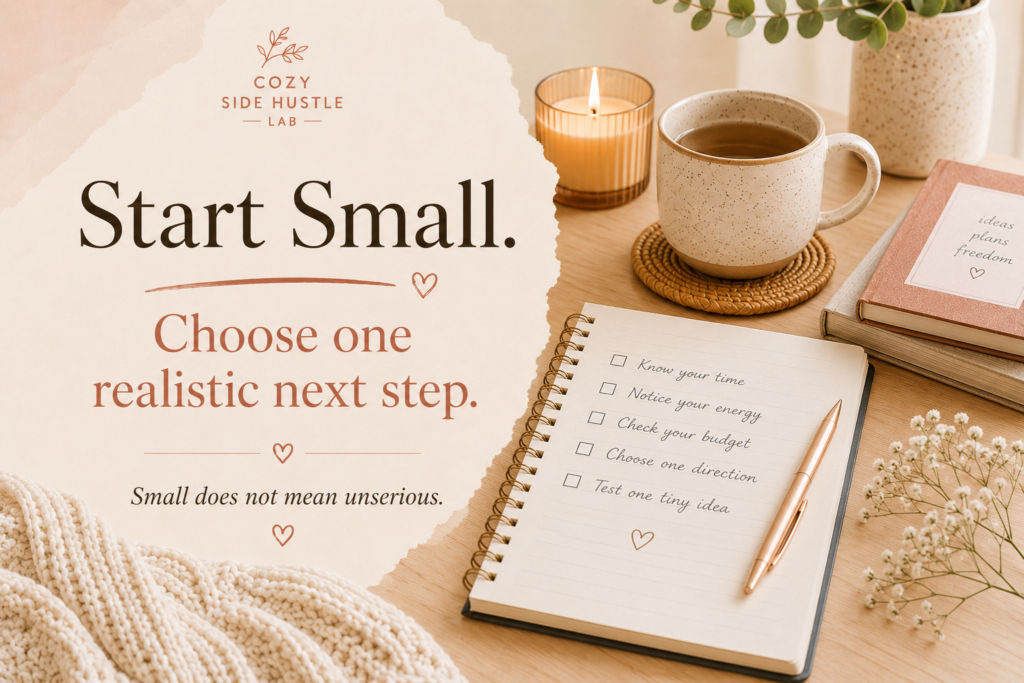
Small does not mean unserious. Small means clear enough to begin.
Why This Matters for a Cozy Side Hustle
A cozy side hustle is not about doing the easiest thing forever.
It is about building in a way that is sustainable enough for your real life.
Where many beginners get stuck is choosing a side hustle based on someone else’s results. They see a creator talk about making money with a certain platform or product, and they assume that must be the best path.
But online income is not one-size-fits-all.
A side hustle that works beautifully for a high-energy extrovert may feel impossible for someone who needs quiet work. A side hustle that makes sense for someone with a large budget may not be wise for a beginner who needs to keep costs low. A side hustle that requires daily content may not fit someone with unpredictable energy.
In practice, this means your best side hustle is not always the trendiest one.
It is the one you can return to consistently.
A calm side hustle should:
- fit your current life;
- be possible to start small;
- avoid unnecessary pressure;
- match your available energy;
- respect your budget;
- give you room to learn;
- have a realistic path toward income;
- not require you to become someone you are not.
This approach may not be ideal if you need guaranteed income immediately, want a fully passive income stream from day one, or do not want to learn any new tools or skills.
But if you want a realistic, beginner-friendly way to build something online slowly, this kind of decision-making can save you a lot of wasted time and overwhelm.
The Main Benefits of Choosing Carefully
You avoid wasting energy on the wrong thing
A side hustle can look exciting from the outside and still drain you in practice.
If you hate video, a video-heavy side hustle may not be the best first choice. If you dislike client communication, a service-based side hustle may feel stressful. If you need money quickly, a slow-growing blog may feel frustrating.
Choosing carefully helps you avoid building something that works against your natural energy.
You lower the risk of quitting early
Many beginners quit because they choose a plan that is too big.
They start with a full website, five social platforms, an email list, a product shop, a content calendar, and a logo — before they have even tested whether they like the idea.
A realistic first step is much more powerful.
When your first version is small, you are more likely to finish it. And finishing one small thing builds more confidence than planning ten big things.
You spend less money before you understand the idea
It is easy to spend money too early.
A course. A premium theme. A logo. A fancy tool. A paid subscription. A planner. Another template. Another tool.
Sometimes those things help. But often, beginners buy tools because they are trying to feel ready.
Choosing the right side hustle includes choosing the right budget level.
You can often start with simple tools first, such as Canva, Google Docs, Pinterest, Etsy, WordPress, or a basic email platform.
You build around your real capacity
Your side hustle should not require a version of you who has unlimited time, unlimited focus, and unlimited emotional energy.
If you only have three hours per week, that matters.
If you are tired in the evenings, that matters.
If you need a quiet, low-pressure project, that matters.
You are allowed to build this in a way that works for your real life.
You make clearer decisions
When you know your time, energy, and budget limits, it becomes easier to say no.
You can stop asking, “Is this a good side hustle?”
And start asking, “Is this a good side hustle for me right now?”
That one shift can make the whole process feel calmer.
The Honest Downsides or Challenges
Choosing carefully does not remove all difficulty.
It simply helps you choose difficulty that makes sense.
You may have to let go of exciting ideas
Some ideas may sound fun but not fit your current season.
For example, you may love the idea of a big YouTube channel, but if you have no capacity to film or edit right now, it may be better to save that idea for later.
That does not mean “never.”
It means “not first.”
The right choice may not be the fastest-looking choice
A calm, realistic side hustle may not sound as dramatic as a viral success story.
But slow can still be strategic.
A blog, digital product shop, Pinterest system, or email list may take time to grow. But if it fits your life, you are more likely to keep going long enough to learn and improve.
You still need to test
No planning process can guarantee that an idea will work.
You can make a thoughtful choice and still need to adjust.
Maybe the product needs a clearer audience. Maybe your blog niche is too broad. Maybe your service offer needs to be simpler. Maybe you thought you liked a platform, but you do not.
That is normal.
A side hustle is not chosen perfectly once. It is shaped over time.
It can be hard to be honest about your capacity
Many people choose side hustles based on the life they wish they had.
But your real schedule matters.
If you have two hours per week, choose a two-hour-per-week starting plan. Do not choose a strategy that requires daily content, weekly launches, client calls, and constant social media.
Your current capacity is not a personal failure. It is useful information.
How to Know If This Is Right for You
This guide is for you if you want to choose a side hustle calmly instead of jumping into the first idea that sounds profitable.
This may be a good fit if…
You want to make extra money from home, but you need the idea to fit around your real life.
You may only have a few hours per week. You may be creative but easily overwhelmed. You may prefer quiet work. You may want to build something slowly instead of chasing fast results.
This approach is especially helpful if you are choosing between:
- blogging;
- printables;
- Canva templates;
- Etsy digital products;
- Pinterest marketing;
- affiliate income;
- freelance services;
- niche websites;
- digital planners;
- email lists.
This may not be the best fit if…
This may not be the best fit if you are looking for guaranteed income, instant results, or a side hustle that requires no learning at all.
Every real side hustle requires some effort.
The goal is not to find an effortless option. The goal is to find an option that asks for the kind of effort you can realistically give.
Choose this type of side hustle if…
If you enjoy writing, consider blogging, affiliate content, email newsletters, or niche websites.
If you enjoy design, consider printables, Canva templates, Etsy digital products, or Pinterest graphics.
If you enjoy systems, consider digital planners, Notion templates, content calendars, or simple business tools.
If you enjoy helping people directly, consider freelance services, virtual assistant work, Pinterest support, or Canva design services.
If you dislike being on camera, consider blogging, Pinterest, Etsy digital products, printables, templates, affiliate content, or faceless tutorials.
If you need money sooner, consider a service first.
If you want a long-term asset, consider content, digital products, Pinterest, affiliate marketing, or an email list.
If you have very little energy, start with one tiny offer or one small piece of content.
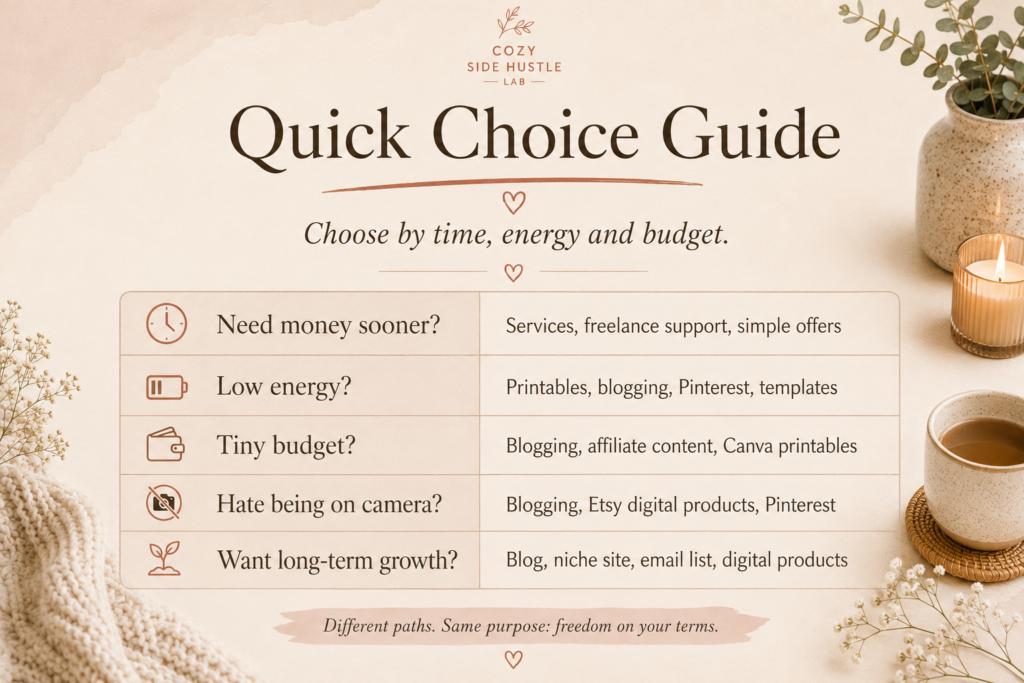
Quick Choice Guide: Choose by Time, Energy and Budget
| Your situation | Best first options | Why this may fit |
|---|---|---|
| You have very little time | One printable, one service offer, one blog post | Small enough to complete without overwhelm |
| You have low energy | Printables, Pinterest, blogging, templates | Can be done quietly in small batches |
| You need money sooner | Freelance service, Canva design, virtual assistant work | You can sell a skill directly |
| You have a tiny budget | Blogging, Canva printables, affiliate content, Pinterest | Low-cost tools can be enough to start |
| You dislike being on camera | Blogging, Etsy digital products, Pinterest, niche websites | You can build without a loud personal brand |
| You love design | Canva templates, printables, Pinterest graphics | Visual skills become useful assets |
| You love writing | Blog, affiliate content, email list, paid guide | Writing can support long-term income streams |
| You want long-term growth | Blog, niche website, email list, digital products | These can become assets over time |
The Cozy Side Hustle Decision Framework
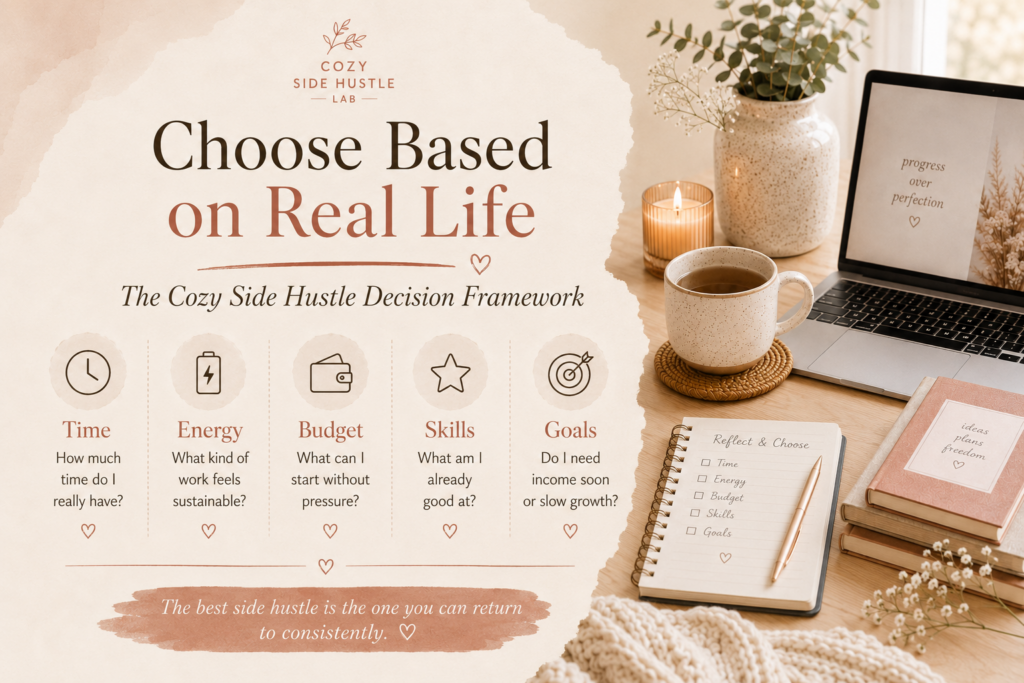
Instead of choosing a side hustle from a random list, use these five filters.
1. Time: How many hours do you truly have?
Be honest here.
Not your dream schedule. Not your most productive week. Your normal, realistic week.
Ask yourself:
- Do I have 1 to 2 hours per week?
- Do I have 3 to 5 hours per week?
- Do I have 5 to 10 hours per week?
- Are my hours predictable or scattered?
- Do I work better in short bursts or longer sessions?
If you have 1 to 2 hours per week, choose something very small:
- one printable;
- one simple service;
- one blog post per month;
- one Pinterest experiment;
- one affiliate article;
- one small template pack.
If you have 3 to 5 hours per week, you may be able to build a simple system:
- a blog with Pinterest;
- an Etsy shop with one product type;
- a small service offer;
- a basic email freebie;
- a template shop;
- a niche content site.
If you have 5 to 10 hours per week, you may be able to handle more moving parts, but still avoid doing everything at once.
Time helps you choose the size of the first version.
2. Energy: What kind of work drains or restores you?
Time is not the only factor.
Two hours of work can feel easy or impossible depending on the type of task.
Ask yourself:
- Do I enjoy writing?
- Do I enjoy designing?
- Do I enjoy talking to clients?
- Do I enjoy research?
- Do I enjoy making systems?
- Do I enjoy visual platforms?
- Do I dislike being visible online?
- Do I need quiet, low-stimulation work?
If writing feels calm, blogging or affiliate content may fit.
If designing feels fun, printables or Canva templates may fit.
If direct communication feels okay, services may fit.
If client work drains you, digital products or content may be better.
If social media feels overwhelming, Pinterest, SEO, Etsy search, or blogging may be more comfortable.
Your energy pattern matters because consistency becomes easier when the work does not fight your personality.
3. Budget: What can you start without financial pressure?
Your side hustle should not create panic before it creates income.
Some side hustles require more upfront investment than others.
Low-budget options may include:
- blogging with basic hosting;
- Canva printables;
- Pinterest marketing;
- affiliate content;
- simple freelance services;
- Etsy digital products;
- email list building with a free or low-cost plan.
Higher-budget options may include:
- paid ads;
- advanced courses;
- custom branding;
- premium tools;
- inventory-based products;
- complex websites;
- professional video equipment.
At the beginning, avoid spending money to feel more prepared.
Spend only when it supports the next practical step.
A realistic first step is to ask:
“What is the simplest version I can test without putting pressure on my budget?”
4. Skill fit: What do you already know enough to begin?
You do not need to be an expert.
But it helps to begin with something connected to your existing skills or interests.
For example:
- If you already use Canva, try templates or printables.
- If people ask you for advice, turn that into blog topics.
- If you are organized, consider planners, checklists, or VA services.
- If you enjoy comparing tools or products, consider affiliate content.
- If you like creating systems, consider digital planners.
- If you enjoy quiet research, consider niche websites.
You can learn as you go. But starting from something familiar makes the first step less intimidating.
5. Income timeline: Do you need money soon or later?
This is one of the most important filters.
If you need money sooner, choose a side hustle where you can offer a direct service.
Examples:
- Canva design;
- virtual assistant work;
- Pinterest pin creation;
- blog formatting;
- product description writing;
- simple content support;
- basic admin support.
Service work is not passive, but it can be more direct.
If you want long-term asset building, consider:
- blogging;
- affiliate content;
- email lists;
- printables;
- digital products;
- Pinterest;
- niche websites;
- templates.
These can be flexible and scalable, but they often take longer.
Neither path is better.
They serve different needs.
Side Hustle Types by Time, Energy and Budget
Service-based side hustles: best if you need money sooner
Service-based side hustles involve helping someone directly.
Examples include virtual assistant work, Canva design, Pinterest support, simple freelance writing, blog formatting, or admin support.
These are good if you want a clearer path to income because you are selling your time and skill.
A realistic first step is to choose one simple service you can offer confidently.
For example:
“I create 10 Pinterest pins in Canva for beginner bloggers.”
That is much clearer than:
“I can help with online business stuff.”
The honest challenge is that service work requires communication, deadlines, and client expectations. It can be flexible, but it is not always low-energy.
Choose this if you need money sooner and do not mind working directly with people.
Digital product side hustles: best if you enjoy creating useful resources
Digital products include printables, Canva templates, digital planners, worksheets, mini ebooks, trackers, and downloadable guides.
These are good if you enjoy creating something once and improving it over time.
A realistic first step is to create one tiny product for one specific audience.
For example:
- a weekly reset checklist for overwhelmed beginners;
- a Pinterest pin template pack for bloggers;
- a budget tracker for families;
- a content planner for new Etsy sellers.
The honest challenge is that digital products still need traffic. You need a way for people to find them, such as Etsy search, Pinterest, blogging, or an email list.
Choose this if you enjoy design, planning, organization, or creating helpful tools.
Content-based side hustles: best if you enjoy writing or teaching
Content-based side hustles include blogging, affiliate articles, niche websites, newsletters, tutorials, and helpful guides.
These are good if you enjoy explaining things and building slowly.
A realistic first step is to choose one niche and write one genuinely helpful article.
For example:
“How to Start a Simple Printable Side Hustle with Canva.”
The honest challenge is that content takes time to grow. Google, Pinterest, and audience trust do not usually happen overnight.
Choose this if you want a long-term asset and can be patient.
Pinterest-based side hustles: best if you like visual search
Pinterest can support blogs, Etsy shops, digital products, affiliate content, and freebies.
It can also become a service if you help other creators with Pinterest graphics or setup.
A realistic first step is to create five pins for one blog post, product, or freebie.
The honest challenge is that Pinterest requires testing. Designs, titles, keywords, and consistency all matter.
Choose this if you enjoy visuals and want a quieter alternative to traditional social media.
Email list side hustles: best if you want to build trust slowly
An email list is not usually a side hustle by itself at the beginning, but it can become the center of a calm online income system.
You can use an email list to share tips, promote digital products, recommend affiliate tools, or invite people into future offers.
A realistic first step is to create a simple freebie.
Examples:
- a starter checklist;
- a quiz;
- a mini workbook;
- a planning template;
- a beginner resource guide.
The honest challenge is that people need a clear reason to subscribe. “Join my newsletter” is usually not enough.
Choose this if you want to build trust and avoid relying only on algorithms.
AI-supported side hustles: best if you need help organizing ideas
AI can be helpful, but it should not replace your thinking, taste, experience, or voice.
For this topic, AI is best seen as a support tool.
You can use AI to help brainstorm blog ideas, outline product descriptions, create Pinterest title options, organize content plans, or turn one idea into several content angles.
A realistic first step is to ask AI for 10 ideas based on your skills and audience, then choose one and refine it yourself.
The honest challenge is that AI can produce generic ideas if you do not guide it well. Your judgment still matters.
Choose this if blank pages slow you down and you want help organizing your thoughts.
Step-by-Step Beginner Plan
Step 1: Write down your real limits
Start with your actual situation.
Write down:
- how many hours you have per week;
- when those hours happen;
- your current energy level;
- your starting budget;
- whether you need income soon or can build slowly.
This is not meant to discourage you. It helps you choose wisely.
Step 2: Choose your income timeline
Ask yourself:
“Do I need money sooner, or am I building a long-term asset?”
If you need money sooner, start with a service.
If you can build slowly, consider blogging, digital products, Pinterest, affiliate content, or a niche website.
If you are unsure, you can combine both later. But begin with one main priority.
Step 3: Pick your lowest-friction work style
Choose the type of work that feels easiest to return to.
For example:
- writing;
- designing;
- organizing;
- researching;
- teaching;
- helping;
- creating systems;
- making visual content.
Your first side hustle does not have to be your forever business. It just needs to be a realistic starting point.
Step 4: Choose one audience and one problem
Do not try to help everyone.
Choose one group and one problem.
Examples:
- beginner bloggers who need Pinterest templates;
- overwhelmed parents who need weekly planning printables;
- Etsy sellers who need product description help;
- side hustlers who need a content calendar;
- busy people who need simple meal planning tools.
This makes your offer clearer.
Step 5: Create one tiny first version
Create the smallest useful version of your idea.
Examples:
- one service package;
- one printable;
- one blog post;
- one Etsy listing;
- one Pinterest board;
- one freebie;
- one mini guide outline;
- one Canva template pack.
Do not build the full ecosystem yet.
Build the first piece.
Step 6: Choose one platform
Pick one main place to publish, sell, or promote.
Examples:
- Etsy for digital products;
- WordPress for blogging;
- Pinterest for traffic;
- email for relationship-building;
- a simple services page for client work.
One platform is enough at the beginning.
Step 7: Review after 30 days
After 30 days, ask:
- Did I actually enjoy working on this?
- Was the workload realistic?
- Did I finish something?
- Did I learn something useful?
- Did anyone click, ask, save, view, or respond?
- What would I simplify next?
Your first month is not about proving everything.
It is about learning what fits.
A Realistic Example
Let’s imagine Nora.
Nora wants to start a side hustle, but she only has three hours per week. She is introverted, has a small budget, and feels tired after work. She likes Canva, planning, and quiet creative tasks.
At first, she considers starting a YouTube channel because she sees people talking about it online.
But when she looks honestly at her energy, she realizes filming and editing would probably drain her.
So she chooses a calmer first idea: printable weekly planning pages for overwhelmed beginners.
She starts with one tiny product: a three-page weekly reset printable.
It includes:
- a weekly overview;
- a top priorities page;
- a simple home reset checklist.
She creates the product in Canva and lists it on Etsy. Then she makes five Pinterest pins linking to the product.
She also uses AI to brainstorm product description ideas and Pinterest titles, but she edits everything herself so it sounds warm, clear, and specific.
After the first few weeks, she does not have dramatic results. But she does learn.
She notices which pin titles are clearer. She sees that her mockup could be better. She realizes people may want a matching meal planner.
So her next step is not to start five new side hustles.
Her next step is to improve the listing and create one related printable.
That is a cozy side hustle approach.
Small. Focused. Realistic. Built around her actual time, energy, and budget.
Common Beginner Mistakes
Mistake 1: Choosing based only on income potential
This happens when you see someone else’s success and assume their side hustle is the best option.
But income potential does not matter much if the work does not fit your life.
What to do instead:
Choose based on fit first, then look at income potential. Ask whether you can realistically work on the idea for three months.
Mistake 2: Ignoring your real schedule
Many beginners create plans for an imaginary version of themselves with unlimited evenings and perfect focus.
Then real life happens.
What to do instead:
Build your side hustle around your actual week. If you have two hours, choose a two-hour starting plan.
Mistake 3: Spending too much before testing
Buying tools can feel like progress.
But it can also become expensive procrastination.
What to do instead:
Start with the simplest tools possible. Invest later when you know what you are building.
Mistake 4: Choosing a side hustle that drains your energy
A side hustle may look good online but feel terrible in practice.
For example, client work may drain you. Or daily social media may feel too intense. Or writing long blog posts may feel impossible.
What to do instead:
Pay attention to the type of work, not just the business model.
Mistake 5: Starting with too many platforms
It is tempting to start everywhere: Etsy, Pinterest, Instagram, TikTok, blog, newsletter, YouTube.
That usually creates overwhelm.
What to do instead:
Choose one main platform and one simple next step.
Mistake 6: Waiting for the perfect idea
You can spend months trying to choose the perfect side hustle.
But clarity often comes from action.
What to do instead:
Choose a small test. Give it 30 days. Learn from what happens.
Mistake 7: Treating the first idea as forever
Your first side hustle does not have to be your final business.
It can be a learning project.
What to do instead:
Start small enough that you can learn without feeling trapped.
What to Do Today
Set a timer for 20 minutes.
Write three lists:
- Time: How many hours do I realistically have each week?
- Energy: What kind of work feels least draining to me?
- Budget: What can I start without creating financial pressure?
Then choose one matching direction:
- If you need money sooner: choose one simple service.
- If you love design: choose one printable or Canva template.
- If you love writing: choose one blog post or affiliate article.
- If you dislike being visible: choose Pinterest, blogging, Etsy, or niche content.
- If you have low energy: choose one tiny product or one small content piece.
Your action today is not to build the whole side hustle.
Your action is to choose the first realistic test.
That is enough.
FAQ
How do I choose the right side hustle?
Choose the right side hustle by looking at your time, energy, budget, skills, and income timeline. A good side hustle should fit your real life, not just sound profitable online. Start with one small test before committing to a big plan.
What is the best side hustle if I have very little time?
If you have very little time, choose a small and focused side hustle such as one printable, one Canva template pack, one simple service offer, one blog post per month, or one Pinterest-based experiment. Avoid side hustles that require daily content at the beginning.
What side hustle can I start with a small budget?
Low-budget side hustles include blogging, affiliate content, Canva printables, Etsy digital products, Pinterest marketing, simple freelance services, and niche websites. Start with simple tools before investing in advanced software or courses.
Should I choose a service or digital product side hustle?
Choose a service if you need income sooner and are comfortable working with clients. Choose digital products if you want to build something that can sell more than once, but understand that it may take longer to get traffic and sales.
What side hustle is best if I have low energy?
If you have low energy, consider quiet side hustles that can be done in small batches, such as printables, blogging, Pinterest, templates, affiliate content, or niche websites. Start with one tiny project instead of a full business setup.
Do I need to be on social media to start a side hustle?
No, you do not always need to be on social media. You can build through blogging, Pinterest, Etsy search, Google search, affiliate content, email lists, or niche websites. Social media can help, but it is not the only path.
Can AI help me choose or build a side hustle?
Yes, AI can help you brainstorm ideas, organize your thoughts, outline blog posts, write product description drafts, and plan content. But AI should support your judgment, experience, and voice. It should not choose everything for you or replace your own decision-making.
Conclusion
Choosing the right side hustle is not about finding the one perfect idea that guarantees success.
It is about choosing one realistic starting point that fits your time, energy, budget, and current life.
You do not need to do everything at once. You do not need to become a loud online personality. You do not need a perfect brand before you begin.
You can start small.
You can build slowly.
You can test one idea, learn from it, and adjust as you go.
A cozy side hustle should support your life, not consume it. And sometimes the most strategic thing you can do is choose the simple idea you can actually return to next week.
Small does not mean unserious.
Slow can still be strategic.
Call to Action
Want help choosing your first calm and realistic side hustle? Join the Cozy Side Hustle Lab list for beginner-friendly ideas, simple tools, and gentle next steps as they become available. You can also save this guide for later when you are ready to choose your first tiny step.