Side Hustle Ideas for Women: Calm and Creative Ways to Make Extra Money from Home
Introduction
If you have been searching for side hustle ideas for women, you have probably found a lot of advice that sounds exciting at first and exhausting a few minutes later.
Start a business. Post every day. Build a personal brand. Sell digital products. Launch a newsletter. Make passive income. Do it all before breakfast.
No wonder so many beginners feel overwhelmed before they even begin.
Maybe you do want to make extra money from home. Maybe you want more breathing room in your budget, a creative outlet, or a small online income stream that feels like yours. But you may not want your side hustle to become another thing that drains you.
That is where Cozy Side Hustle Lab takes a different approach.
A calm side hustle should support your life, not consume it. You do not need a loud personal brand, endless energy, or a perfect plan to begin. You can start small, build slowly, and choose one idea that fits your real life.
In this guide, you will find realistic, creative side hustle ideas from home, grouped by type, with practical first steps and honest notes so you can choose more clearly.
What Are Side Hustle Ideas for Women?
Side hustle ideas for women are flexible ways to earn extra income outside of your main job, family role, caregiving responsibilities, studies, or other commitments.
A side hustle can be online or offline. It can be creative, practical, product-based, service-based, content-based, or a mix of several things.
For this guide, we will focus mostly on online side hustles you can build from home, such as:
- blogging;
- digital products;
- printables;
- Canva templates;
- Etsy digital products;
- Pinterest marketing;
- affiliate content;
- simple niche websites;
- email lists;
- low-pressure online business systems.
A side hustle does not have to become a full-time business.
It can be a small project that helps you earn extra money, learn new skills, build confidence, create more options, or slowly grow into something larger.
For example, a side hustle could be:
- selling a printable weekly planner on Etsy;
- writing blog posts about a specific topic;
- creating Pinterest templates for bloggers;
- offering simple Canva design services;
- building a small niche website with affiliate links;
- creating a free checklist and growing an email list;
- selling digital activity packs for parents or teachers.
This can be simple at the beginning.
You do not need to have everything figured out yet. You only need one clear starting point.
Why This Matters for a Cozy Side Hustle
A cozy side hustle is not about avoiding effort.
It is about choosing effort that fits your real life.
Many people do not quit side hustles because they are lazy or incapable. They quit because the side hustle they chose required too much energy, too much visibility, too much complexity, or too many moving parts too soon.
Where many beginners get stuck is choosing an idea based on what looks successful for someone else.
But your best side hustle depends on your own situation.
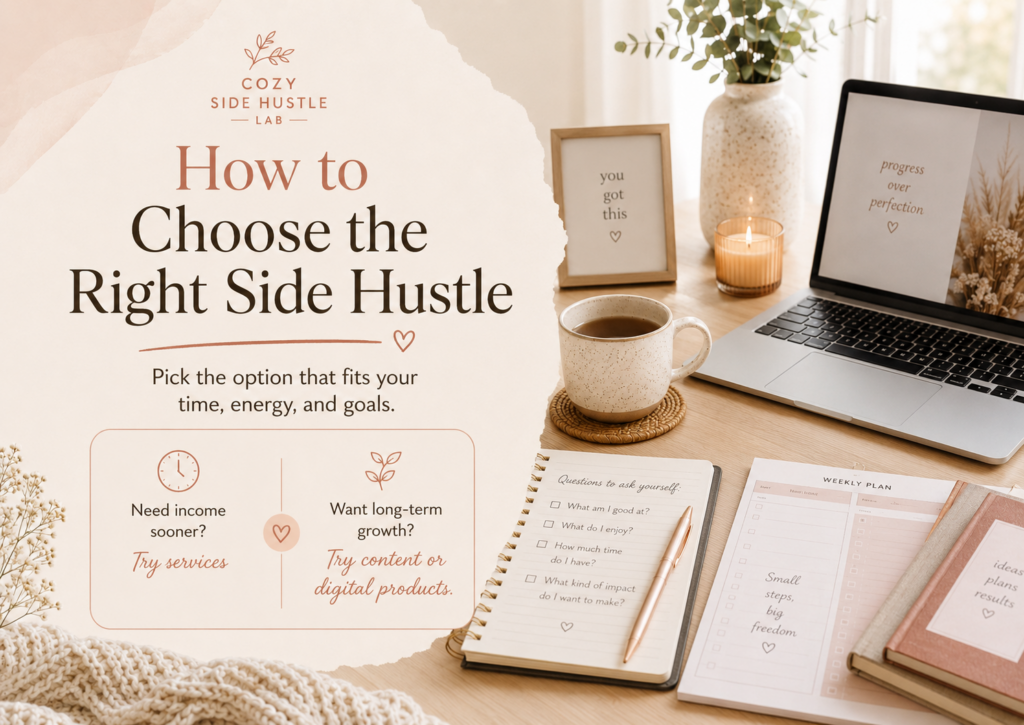
If you only have three hours per week, you need a focused plan.
If you are introverted, you may prefer quiet or faceless side hustles.
If you need income sooner, services may be more realistic than blogging.
If you want a long-term asset, digital products, Pinterest, blogging, or niche websites may fit better.
If you are low on energy, starting with one small product or one simple service may be enough.
A cozy side hustle may be a good fit if you want:
- flexible work from home;
- a creative but practical income idea;
- a low-pressure online business model;
- something you can start small;
- a path that does not require constant social media;
- a project that can grow slowly over time.
This may not be ideal if you need guaranteed money immediately, dislike learning new tools, or need a predictable paycheck by a specific date.
Online side hustles can be realistic, but they are not magic. They require learning, testing, and consistency.
Slow can still be strategic, but it helps to choose the right kind of slow.
The Main Benefits of Creative Side Hustles from Home
You can start with skills you already have
Many beginners think they need a completely new skill before they can start.
But you may already have more useful skills than you realize.
You might be good at organizing information, writing clearly, making simple designs, explaining things, researching products, planning routines, helping others, or spotting what makes something easier.
Those skills can turn into side hustle ideas.
For example:
- if you enjoy writing, you could start a blog;
- if you enjoy design, you could create Canva templates;
- if you love planning, you could sell printables;
- if you enjoy research, you could create affiliate content;
- if you like systems, you could create digital planners;
- if you enjoy helping directly, you could offer a simple service.
You do not need to be the biggest expert online. You can help someone who is a few steps behind you.
You can build around your energy
Some side hustles require a lot of live interaction, video content, or daily posting.
Others can be quieter.
Blogging, printables, templates, Pinterest, niche websites, affiliate content, and email-based systems can often be built in smaller blocks of time.
That does not make them effortless. But it can make them more realistic if you are busy, sensitive, introverted, or working with limited energy.
You can keep the first version simple
You do not need a full brand, a giant product shop, or a complete website before you start.
A realistic first step might be:
- one blog post;
- one printable;
- one Etsy listing;
- one Canva template pack;
- one Pinterest board;
- one freebie;
- one simple service offer.
Small does not mean unserious.
Small means you are giving yourself room to learn.
You can create long-term assets
Some side hustles are based only on trading time for money. That can be useful, especially when you need income sooner.
Other side hustles can become assets over time.
For example:
- a blog post can keep bringing traffic;
- a printable can sell more than once;
- a Pinterest pin can send visitors to your site;
- an email list can become a long-term audience;
- a niche website can grow into a content asset;
- a template shop can expand product by product.
This is not instant passive income. But it can become a more sustainable foundation over time.
You can choose a quieter path
You do not need a loud personal brand to begin.
You can build around search, helpful resources, digital products, Pinterest, templates, email, or niche content.
For many people, that feels much more doable than performing online every day.
The Honest Downsides or Challenges
Creative side hustles from home can be flexible and meaningful, but they also come with real challenges.
It can take time to earn consistently
Some side hustles can bring income sooner, especially service-based work.
But blogging, affiliate income, Etsy digital products, Pinterest traffic, and niche websites usually take time.
You may need to create, publish, test, improve, and learn before the results feel steady.
That does not mean you are failing. It means you are building.
There is a learning curve
Depending on your idea, you may need to learn:
- Canva;
- WordPress;
- Etsy SEO;
- Pinterest keywords;
- basic website setup;
- email marketing;
- product descriptions;
- affiliate disclosures;
- simple analytics.
You do not need to learn everything at once.
A calm approach is to learn only what you need for the next step.
Too many options can become overwhelming
A big list of ideas is only helpful if it helps you choose.
Otherwise, it becomes another form of pressure.
You might start thinking you need a blog, Etsy shop, Pinterest account, newsletter, product line, and social media strategy all at once.
You do not.
The goal is not to do everything. The goal is to build one small thing that fits your life.
Competition is real
Many online side hustles are accessible, which means other people are doing them too.
That is not a reason to stop.
It is a reason to get more specific.
A general “planner shop” is harder to position than “printable weekly reset planners for overwhelmed beginners” or “Canva Pinterest templates for cozy lifestyle bloggers.”
Specificity helps the right person recognize your offer.
Motivation will come and go
At the beginning, excitement can carry you.
Later, you need a simple routine.
Two calm hours per week can be more useful than one intense weekend followed by a month of avoidance.
Your side hustle does not have to become another source of pressure. But it does need a little consistency.
How to Know If This Is Right for You
Before choosing from a list of side hustle ideas for women, it helps to understand what kind of side hustle fits your current season.
This may be a good fit if…
This kind of calm, online side hustle may fit you if:
- you want to work from home;
- you like creative or helpful projects;
- you need flexible hours;
- you want to start small;
- you are willing to learn slowly;
- you prefer low-pressure online business systems;
- you want something that can grow over time.
This may not be the best fit if…
This may not be the best fit if:
- you need guaranteed income immediately;
- you do not want to learn any new tools;
- you need a fixed paycheck quickly;
- you dislike testing and improving;
- you want a fully passive income stream from day one.
If you need money sooner, consider a service-based side hustle first.
If you want a long-term asset, consider blogging, digital products, Pinterest, affiliate content, or a niche website.
Choose based on what you enjoy doing
If you enjoy writing, consider blogging, affiliate content, or niche websites.
If you enjoy design, consider Canva templates, printables, or Etsy digital products.
If you enjoy systems, consider digital planners, Notion templates, or business organization tools.
If you enjoy helping directly, consider freelance services or virtual assistant work.
If you dislike being on camera, consider blogging, Pinterest, printables, templates, email lists, or faceless niche content.
If you have very little time or energy, start with one tiny product, one simple service, or one helpful blog post.
Quick Choice Guide: Which Side Hustle Fits You Best?
| If you want… | Consider… | Why it may fit |
|---|---|---|
| Income sooner | Freelance services, virtual assistant work, Canva design | You can sell a skill directly instead of waiting for traffic |
| A quiet, faceless option | Blogging, Pinterest, Etsy digital products, niche websites | You do not need to be on camera every day |
| A creative product | Printables, Canva templates, digital planners | You can create useful resources from home |
| A long-term asset | Blogging, affiliate content, email list, niche website | These can grow slowly over time |
| Something low-energy to start | One printable, one checklist, one small service | You can test a small idea before building more |
| A visual side hustle | Pinterest marketing, templates, Etsy products | Good if you enjoy graphics, design, and visual content |
| A writing-based side hustle | Blogging, affiliate articles, paid guides | Good if you like explaining and organizing information |
Creative Side Hustle Ideas from Home
Instead of giving you one long list, let’s group these ideas by the kind of work they involve.
Content-Based Side Hustles
Content-based side hustles are best if you enjoy writing, researching, teaching, reviewing, explaining, or organizing information.
They often take longer to grow, but they can become valuable long-term assets.
1. Start a beginner-friendly blog
A blog is a website where you publish helpful articles around a specific topic.
You could blog about budgeting, cozy productivity, beginner side hustles, parenting routines, printables, crafts, simple home systems, digital products, or another focused niche.
Good for:
People who enjoy writing, research, teaching, and slow asset-building.
Why it can work:
A blog can bring traffic through Google, Pinterest, and internal links. Over time, it can support affiliate income, ads, digital products, email signups, or sponsored content.
Realistic first step:
Choose one narrow topic and write one helpful article that answers a real beginner question.
Example: “How to Plan Your Week When You Feel Overwhelmed.”
Honest note:
Blogging usually takes time. It is not the best option if you need income immediately.
2. Build a simple niche website
A niche website is a focused site about one specific topic.
Examples include:
- cozy desk setup ideas;
- beginner crochet projects;
- printable party games;
- easy toddler activities;
- simple meal planning;
- small space organization;
- digital planning tools;
- pet memorial ideas.
Good for:
People who enjoy research and want to build quietly without becoming the face of a personal brand.
Why it can work:
A niche website can attract search traffic and earn through affiliate links, ads, digital products, or an email list.
Realistic first step:
Write down 20 questions beginners might ask about one niche.
Honest note:
You need patience. Search-based content usually takes time to gain traction.
3. Create affiliate content
Affiliate marketing means recommending useful products, tools, or resources and earning a commission if someone buys through your link.
This can work through blog posts, tutorials, comparison guides, resource pages, gift guides, or email newsletters.
Good for:
People who enjoy research, helpful recommendations, product comparisons, or tutorials.
Why it can work:
Affiliate content can fit naturally into a blog or niche website when it genuinely helps the reader make a good decision.
Realistic first step:
List 10 tools, books, products, or resources you already know well enough to explain honestly.
Honest note:
Trust matters. Do not recommend random products just because they have affiliate programs.
Digital Product Side Hustles
Digital product side hustles are best if you enjoy creating useful resources people can download, customize, print, or use online.
They are not fully passive at the beginning, but they can become scalable over time.
4. Sell printables
Printables are digital files people download and print at home.
Examples include:
- planners;
- habit trackers;
- budget sheets;
- meal planners;
- cleaning checklists;
- homeschool pages;
- party games;
- self-care worksheets;
- wall art.
Good for:
People who like Canva, simple design, planning, organization, or creating practical resources.
Why it can work:
Printables are affordable to create and can be sold through Etsy, your own website, or digital product platforms.
Realistic first step:
Create one simple printable that solves one small problem.
Example: a weekly meal planner for busy beginners.
Honest note:
The printable market is competitive. Your product needs a clear audience and useful purpose.
5. Create Canva templates
Canva templates are editable designs customers can customize for their own needs.
Examples include:
- Pinterest pin templates;
- Instagram templates;
- media kits;
- lead magnet templates;
- workbook templates;
- ebook templates;
- planner templates;
- small business brand kits.
Good for:
People who enjoy design, layout, branding, and making things look polished.
Why it can work:
Many bloggers, creators, and small business owners need nice designs but do not want to start from scratch.
Realistic first step:
Create five Pinterest pin templates for one specific type of customer, such as beginner bloggers or Etsy sellers.
Honest note:
Templates need to be easy to edit, not just pretty.
6. Open an Etsy digital product shop
Etsy digital products can include printables, templates, invitations, worksheets, coloring pages, planners, spreadsheets, and more.
Good for:
People who want to sell digital products on a marketplace where shoppers are already searching.
Why it can work:
Etsy has built-in search traffic, which can be helpful when you are starting from zero.
Realistic first step:
Research one product category on Etsy and note common keywords, styles, prices, and customer needs.
Honest note:
Etsy is not effortless. Product photos, keywords, descriptions, reviews, and niche positioning all matter.
7. Create digital planners or Notion templates
Digital planners and Notion templates help people organize their life, content, money, studies, or business.
Examples include:
- content calendars;
- habit dashboards;
- budget trackers;
- student planners;
- meal planning systems;
- project management templates;
- small business dashboards.
Good for:
People who enjoy systems, structure, and organizing information.
Why it can work:
Many people want ready-made systems that save them time and mental energy.
Realistic first step:
Create one simple planner around one use case.
Example: a weekly content planner for beginner bloggers.
Honest note:
Do not make the system too complicated. A tool that overwhelms people will be hard to sell.
Service-Based Side Hustles
Service-based side hustles are often better if you need income sooner because you can offer a skill directly.
They may be less passive, but they can be a practical way to start.
8. Offer Canva design services
You can help bloggers, small business owners, Etsy sellers, or creators with simple Canva designs.
Examples include:
- Pinterest pins;
- social media graphics;
- product mockups;
- worksheets;
- lead magnets;
- simple brand graphics.
Good for:
People who enjoy design and want a practical work-from-home service.
Why it can work:
Many business owners need graphics but do not have time to create them.
Realistic first step:
Create three sample designs for one specific type of client.
Honest note:
Client work includes feedback, deadlines, and revisions, so keep your service scope clear.
9. Become a virtual assistant
A virtual assistant helps businesses with online tasks.
Examples include:
- inbox organization;
- customer support;
- blog formatting;
- newsletter formatting;
- file organization;
- content scheduling;
- basic research.
Good for:
People who are organized, reliable, and comfortable helping behind the scenes.
Why it can work:
Many small business owners need support but are not ready to hire a full-time employee.
Realistic first step:
Write a list of five tasks you could confidently offer.
Honest note:
Define your services clearly so you do not become responsible for everything.
10. Offer Pinterest support
Pinterest support can include creating pins, writing pin titles, organizing boards, scheduling content, or helping bloggers and shop owners use Pinterest more consistently.
Good for:
People who enjoy visual content, keywords, and quiet traffic-building systems.
Why it can work:
Pinterest can support blogs, Etsy shops, digital products, and affiliate content.
Realistic first step:
Learn basic Pinterest keywords and create sample pins for one niche.
Honest note:
Pinterest results are not instant. Be careful not to promise quick traffic results to clients.
Quiet or Faceless Side Hustles
These ideas are helpful if you do not want to be on camera or build a personality-heavy brand.
11. Use Pinterest to grow traffic
Pinterest is often more like a visual search engine than a traditional social media platform.
You can use it to send traffic to blog posts, Etsy listings, products, freebies, or affiliate content.
Good for:
People who like visual content, keywords, and low-pressure marketing.
Why it can work:
Pinterest users often search for ideas, solutions, products, and inspiration.
Realistic first step:
Create five pins that link to one useful blog post, product, or freebie.
Honest note:
Pinterest takes testing. Pin design, keywords, and consistency matter.
12. Create faceless educational content
Faceless content can include tutorials, screen recordings, slides, text-based videos, voiceovers, or simple visual explanations.
Examples include:
- Canva tutorials;
- printable business tips;
- digital planning walkthroughs;
- cozy productivity tips;
- beginner blogging explanations;
- simple tool tutorials.
Good for:
People who like teaching but do not want to appear on camera.
Why it can work:
Helpful content can build trust without requiring a highly personal brand.
Realistic first step:
Create one short tutorial that solves a simple problem.
Honest note:
Faceless does not mean effortless. You still need a clear topic and useful content.
13. Create low-content digital products
Low-content digital products include trackers, journals, logs, checklists, coloring pages, prompt cards, worksheets, and activity sheets.
Good for:
People who like simple product creation and visual organization.
Why it can work:
These products can solve small, specific problems and work well as printables or digital downloads.
Realistic first step:
Create one page for one specific audience.
Example: a habit tracker for overwhelmed beginners.
Honest note:
Random low-content products are hard to sell. Specific products for a clear audience work better.
Long-Term Asset-Building Side Hustles
These ideas usually take longer, but they can build valuable foundations over time.
14. Build an email list
An email list helps you stay connected with people who are interested in your topic.
You can send helpful tips, product updates, affiliate recommendations, new blog posts, or gentle weekly notes.
Good for:
People who want to build trust slowly and avoid relying only on social platforms.
Why it can work:
An email list can support future products, affiliate income, blog traffic, and launches.
Realistic first step:
Create a simple freebie idea, such as a checklist, starter guide, quiz, or mini workbook.
Honest note:
People need a clear reason to subscribe. “Join my newsletter” is usually too vague.
15. Create a mini ebook or paid guide
A mini ebook is a small digital resource that solves one clear problem.
Examples include:
- a beginner guide to meal planning;
- a printable business starter guide;
- a Pinterest setup checklist;
- a cozy productivity workbook;
- a simple Canva template guide.
Good for:
People who enjoy explaining a process clearly.
Why it can work:
A small paid guide can become your first digital product without creating a full course.
Realistic first step:
Outline a five-step guide that helps someone solve one specific problem.
Honest note:
A mini ebook still needs a clear audience and a way for people to find it.
16. Use AI as a support tool
AI-assisted content creation should not be treated as a vague side hustle by itself here.
Instead, AI can support many side hustles.
You can use AI to help with:
- brainstorming blog topics;
- outlining product descriptions;
- creating Pinterest title ideas;
- organizing niche research;
- planning email content;
- repurposing one idea into several content pieces;
- creating first drafts you later edit in your own voice.
Good for:
People who feel overwhelmed by blank pages, planning, or organizing ideas.
Why it can work:
AI can reduce friction and help you move faster when used thoughtfully.
Realistic first step:
Ask AI to brainstorm 10 product or blog ideas for one specific audience, then choose only one to develop.
Honest note:
AI should support your judgment, experience, ideas, and voice. It should not replace them.
17. Create a simple product ecosystem
A product ecosystem means your content, freebie, email list, and paid offer connect naturally.
For example:
- blog post: “How to Plan Your Week When You Feel Overwhelmed”
- freebie: weekly reset checklist
- paid product: printable weekly planner bundle
- email sequence: gentle planning tips
Good for:
People who want to build a calm, connected online business over time.
Why it can work:
Each piece supports the next, instead of everything feeling random.
Realistic first step:
Map one simple path from free content to one small paid offer.
Honest note:
Do not start here if you are brand new and overwhelmed. Start with one piece first.
Step-by-Step Beginner Plan
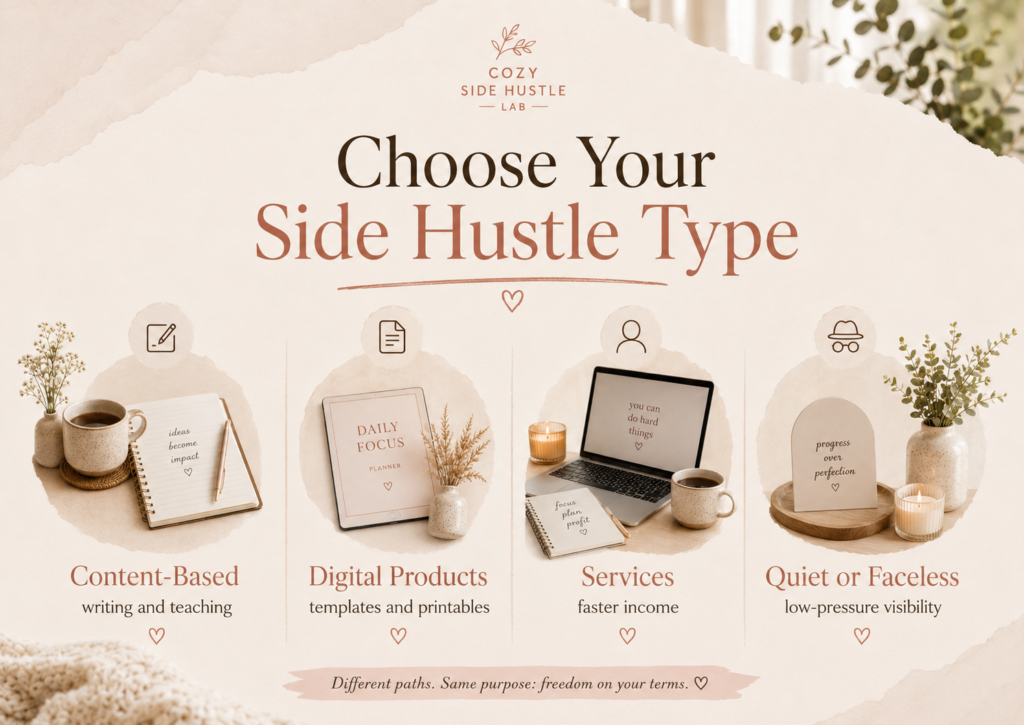
Step 1: Choose your side hustle type
Start by choosing one direction:
- content-based;
- digital product-based;
- service-based;
- quiet or faceless;
- long-term asset-building.
If you need money sooner, choose a service.
If you want a long-term asset, choose blogging, digital products, Pinterest, affiliate content, or a niche website.
If you dislike being visible, choose blogging, Pinterest, Etsy digital products, templates, or niche websites.
Step 2: Choose one specific audience
Your idea becomes easier when you know who you are helping.
Instead of “I want to sell printables,” try:
- printables for overwhelmed moms;
- planners for beginner bloggers;
- Canva templates for Etsy sellers;
- worksheets for preschool parents;
- Pinterest templates for cozy lifestyle bloggers.
Specific does not mean small forever.
It just makes the first step clearer.
Step 3: Pick one problem to solve
Choose one real problem your audience has.
Examples:
- “I need to plan meals faster.”
- “I want better Pinterest graphics.”
- “I need help organizing blog ideas.”
- “I want simple activities for my kids.”
- “I need a calmer weekly routine.”
- “I want to start a side hustle but feel overwhelmed.”
A clear problem makes your content, product, or service easier to create.
Step 4: Create the smallest useful version
Do not build a full brand yet.
Create one small useful thing.
Examples:
- one printable checklist;
- one blog post;
- one Etsy listing;
- one Canva template pack;
- one service offer;
- one freebie;
- one Pinterest board;
- one mini guide outline.
This helps you move from idea to action.
Step 5: Choose one place to publish or sell
Pick one main platform.
Examples:
- Etsy for digital products;
- WordPress for blogging;
- Pinterest for traffic;
- email for relationship-building;
- a simple services page for client work.
You can add more later.
At the beginning, simplicity is a strength.
Step 6: Create helpful content around your idea
Helpful content answers real questions.
If you sell weekly planners, content ideas could include:
- “How to Plan Your Week When You Feel Overwhelmed”
- “A Simple Sunday Reset Routine for Beginners”
- “What to Put in a Weekly Planner”
- “How to Make a Busy Week Feel Less Chaotic”
If you sell Pinterest templates, content ideas could include:
- “How to Make Pinterest Pins That Are Easy to Read”
- “Pinterest Design Tips for Beginner Bloggers”
- “What to Put on a Pinterest Pin”
- “How to Create Pins Faster in Canva”
This is what “valuable content” means in practice: specific help for a specific person.
Step 7: Review and improve slowly
After publishing, look for small signals.
Ask:
- Are people clicking?
- Are they saving?
- Are they viewing the product?
- Are they asking questions?
- Which topics feel easiest to create?
- Which titles seem clearer?
Use what you learn to improve.
You are allowed to build this in a way that works for your real life.
A Realistic Example
Let’s imagine Maya.
Maya wants to make extra money from home, but she only has three hours per week. She is creative, introverted, and does not want to be on camera. She likes Canva and enjoys organizing family life.
Instead of starting a huge lifestyle brand, she chooses one simple idea: printable weekly reset planners for overwhelmed beginners.
Her first product is not a giant planner.
It is a simple five-page printable pack:
- weekly overview;
- meal planning page;
- cleaning checklist;
- top three priorities page;
- self-care reminder page.
She lists it on Etsy.
Then she creates five Pinterest pins that link to the product. She also writes one beginner-friendly blog post: “How to Plan Your Week When Everything Feels Like Too Much.”
She uses AI to brainstorm title ideas and organize her product description, but she edits everything in her own voice and makes sure the product reflects what she actually wants to help with.
At first, things are slow.
She gets a few views, then a few favorites. She notices that people click more on pins with clear titles and simple mockups. She improves her Etsy photos, rewrites her product description, and creates a second product: a Sunday reset checklist.
After a few months, she still does not have a huge business. But she has learned a lot.
She has a small shop, a simple niche, a few products, and a calmer rhythm.
That is a realistic cozy side hustle beginning.
Not overnight success. Not pressure. Just one small asset at a time.
Common Beginner Mistakes
Mistake 1: Choosing the trendiest idea instead of the best-fit idea
This happens because online advice often makes certain side hustles look easy and exciting.
But if the idea does not fit your personality, energy, skills, or current season of life, it becomes hard to continue.
What to do instead:
Choose an idea that feels both useful and doable. Ask yourself, “Could I work on this calmly for the next three months?”
Mistake 2: Starting too many side hustles at once
Beginners often try to start a blog, Etsy shop, Pinterest account, Instagram page, newsletter, and digital product line all at the same time.
That can quickly create overwhelm.
What to do instead:
Choose one main side hustle and one main platform first.
Mistake 3: Creating products without checking demand
It is easy to create something you personally like without checking whether people search for it, need it, or buy similar products.
That can lead to beautiful products that nobody finds.
What to do instead:
Before creating, research Etsy, Pinterest, Google, or competitor blogs. Look for repeated problems, keywords, and product types.
Mistake 4: Waiting until the brand is perfect
Choosing the perfect name, colors, fonts, logo, and website can feel productive.
But it can also delay the real work.
What to do instead:
Create a simple version first. You can improve the brand later.
Mistake 5: Expecting passive income too quickly
Many digital product and blogging side hustles are described as passive.
But they are rarely passive at the beginning.
They require creating, testing, learning, improving, and promoting.
What to do instead:
Think of the first phase as building the foundation, not collecting instant income.
Mistake 6: Ignoring your energy level
A side hustle that looks good on paper may be wrong for your current life.
If you are already exhausted, a high-output content plan may not be sustainable.
What to do instead:
Choose a side hustle that matches your actual capacity. Slow can still be strategic.
Mistake 7: Not giving people a next step
You may create helpful content, but forget to guide readers toward a product, freebie, email list, or related post.
What to do instead:
Add gentle, useful calls to action. Help the reader continue the journey.
What to Do Today
Set a timer for 20 minutes and choose one side hustle direction.
Write down your answers to these three questions:
- What do I enjoy enough to explore for three months?
- Who could I help with that?
- What is one tiny useful thing I could create first?
For example:
“I enjoy Canva and planning. I could help overwhelmed beginners organize their week. I will create one printable weekly reset checklist.”
Or:
“I enjoy writing and research. I could help beginners understand cozy side hustles. I will outline one blog post answering a simple question.”
That is enough for today.
You do not need to decide your entire future business.
You only need one next step.
FAQ
What are the best side hustle ideas for women who want to work from home?
Some of the best side hustle ideas for women who want to work from home include blogging, selling printables, creating Canva templates, offering freelance services, starting an Etsy digital product shop, using Pinterest marketing, and building a simple niche website.
How can I make extra money from home as a beginner?
You can make extra money from home by starting with a simple skill, product, or content idea. If you need income sooner, consider services like Canva design, virtual assistant work, or Pinterest support. If you want to build a long-term asset, consider blogging, digital products, Etsy, or affiliate content.
What is the easiest side hustle to start with no experience?
The easiest side hustle depends on what feels natural to you. Printables, Canva templates, simple freelance services, and beginner blogging can all be good starting points. The key is to start with one small, useful offer or piece of content instead of trying to build everything at once.
What side hustle is best if I do not want to be on camera?
If you do not want to be on camera, consider blogging, Pinterest marketing, Etsy digital products, printables, Canva templates, affiliate websites, email newsletters, or faceless educational content.
Are digital products a good side hustle for women?
Digital products can be a good side hustle if you enjoy creating useful resources such as planners, templates, worksheets, guides, or printables. They can take time to sell consistently, but they are flexible and can be built slowly from home.
How many hours per week do I need for a side hustle?
You can start with just a few hours per week if you keep the side hustle simple. For example, you might spend one hour researching, one hour creating, and one hour publishing or promoting. Consistency matters more than intensity.
Which side hustle makes money the fastest?
Service-based side hustles often have the fastest path to income because you can offer a skill directly to clients. Examples include virtual assistant work, Canva design, Pinterest pin creation, blog formatting, or freelance writing. Asset-based side hustles like blogging and digital products usually take longer to grow.
Conclusion
There are many side hustle ideas for women, but the best one is not always the loudest, trendiest, or fastest-looking option.
The best side hustle is the one that fits your real life.
You can start small. You can build slowly. You can choose a quiet path. You can create something useful without turning your life into a hustle machine.
You do not need to have everything figured out yet.
A cozy side hustle should support your life, not consume it. And choosing one realistic next step is far more useful than collecting endless ideas you never have the energy to start.
Small does not mean unserious.
Slow can still be strategic.
Call to Action
Want help choosing your first calm and realistic side hustle? Join the Cozy Side Hustle Lab list for beginner-friendly ideas, simple tools, and gentle next steps as they become available. You can also save this guide for later when you are ready to choose your first tiny step.
Find the best side hustle that fits your lifestyle.