
Passive Income Ideas for Beginners: What Is Actually Realistic?
Passive income sounds lovely, doesn’t it?
The idea that you can create something once, put it online, and earn money from it later feels peaceful, flexible, and full of possibility.
But if you have spent any time online, you have probably also seen the less helpful version of passive income advice. The kind that makes it sound like you can set up a digital product in one afternoon, wake up to sales the next day, and never think about it again.
That is not the version we are talking about here.
At Cozy Side Hustle Lab, we like the idea of calm online income streams. But we also care about realistic expectations. Passive income can be real, but it is rarely effortless at the beginning.
The good news is that there are beginner-friendly ways to build income streams that may become more passive over time. You do not need a loud personal brand, endless energy, or a perfect business plan to begin.
You just need to understand what is actually realistic, what takes work upfront, and which passive income ideas fit your time, energy, budget, and personality.
What Is Passive Income?
Passive income is money you earn from something that does not require you to trade time for money every single time you get paid.
For example, if you offer a service and a client pays you for one hour of work, that is active income. You do the work once, and you get paid once.
Passive income is different.
You might create a printable planner, publish a blog post with affiliate links, sell a digital template, or build a niche website. The work happens upfront, but the same asset may continue earning later.
That sounds simple, but there is an important truth beginners need to know:
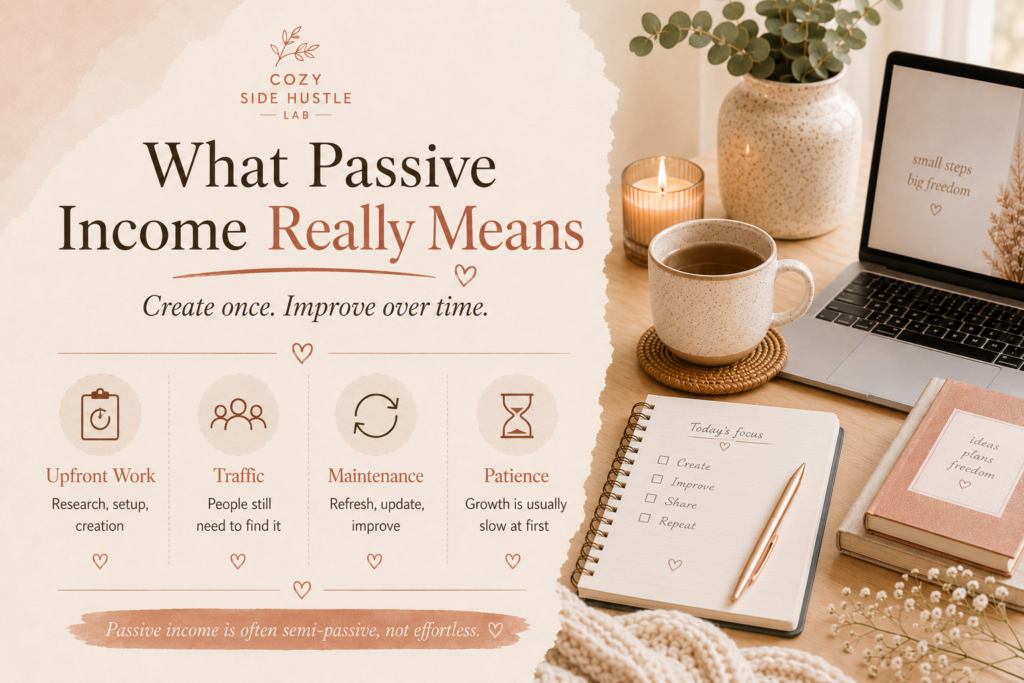
Most passive income is not passive at the start.
It usually requires:
- research;
- setup;
- content creation;
- product creation;
- traffic;
- testing;
- updates;
- promotion;
- patience.
A more realistic phrase might be “asset-based income” or “semi-passive income.”
You create something useful, build a way for people to find it, and improve it over time. Eventually, some parts may keep working even when you are not actively sitting at your desk.
This can be simple at the beginning, but it is not magic.
Why Passive Income Matters for a Cozy Side Hustle
Passive income ideas are attractive for a reason.
Many people who come to Cozy Side Hustle Lab are not looking for a second full-time job. They are already busy, tired, overwhelmed, parenting, working, healing, caregiving, creating, or trying to get through a full week without adding more pressure.
A calm side hustle should support your life, not consume it.
That is why asset-based income can be so appealing. Instead of always needing to show up live, take client calls, or post constantly on social media, you can build small online assets that may keep working over time.
Examples include:
- blog posts;
- digital products;
- printables;
- Canva templates;
- affiliate articles;
- Pinterest pins;
- email sequences;
- Etsy listings;
- simple niche websites.
These are not fully passive from day one. But they can become more spacious than always trading time for money.
Passive income may be a good fit if you want:
- a flexible online side hustle;
- a project you can build slowly;
- less live client work;
- something that can grow over time;
- quiet or faceless income options;
- a business model that does not rely on constant visibility.
It may not be ideal if you need money immediately, dislike slow growth, do not want to create content or products, or expect income without maintenance.
Passive income is not a shortcut around effort.
It is a different kind of effort.
The Main Benefits of Realistic Passive Income Ideas
You can build once and improve over time
With passive income ideas like digital products, blog posts, or affiliate content, your work can continue to exist after you publish it.
A printable can be listed for sale.
A blog post can keep attracting visitors.
A Pinterest pin can continue sending traffic.
An email sequence can welcome new subscribers.
A template can be bought more than once.
You may still need to update and improve things, but the work is not always tied to one single payment.
You can start small
You do not need to build a huge product library or full website right away.
A realistic first step might be:
- one printable;
- one affiliate blog post;
- one resource page;
- one Canva template pack;
- one email freebie;
- one Etsy listing;
- one niche website article.
Small does not mean unserious. Small means you are giving yourself room to learn.
You can avoid some high-pressure business models
Not everyone wants to do discovery calls, live launches, daily reels, webinars, or constant networking.
Passive income ideas can be built more quietly.
That can be helpful if you are introverted, sensitive, low on energy, or simply prefer working behind the scenes.
You do not need a loud personal brand to begin.
You can create long-term assets
An online asset is something you create that may keep supporting your business later.
For example:
- a blog post can lead to affiliate clicks;
- a free checklist can grow your email list;
- an Etsy product can be found through search;
- a Pinterest pin can send traffic to a printable;
- a niche website can grow into a content library;
- an email sequence can introduce readers to your products.
The goal is not to do everything. The goal is to build one small thing that fits your life.
You can combine passive and active income
You do not have to choose only one model.
Some beginners start with service-based work for faster income, then slowly add passive income assets later.
For example, you might offer Canva design services while also creating Canva templates to sell. Or you might do Pinterest client work while building your own blog and affiliate content.
This can be a realistic bridge if you need money sooner but still want long-term online assets.
The Honest Downsides or Challenges
Passive income is often presented as easy, but the realistic version has challenges.
It usually takes time
Most passive income ideas need time before they work.
A blog needs content and traffic.
An Etsy shop needs products, keywords, and reviews.
Affiliate content needs trust and visitors.
A digital product needs buyers to find it.
Pinterest needs testing and consistency.
If you publish one product and nothing happens immediately, that does not automatically mean the idea failed.
It may mean the offer, traffic, keywords, images, or positioning need improvement.
You still need traffic
This is one of the biggest beginner misunderstandings.
Creating the product is only one part.
People also need to find it.
Traffic can come from:
- Google;
- Pinterest;
- Etsy search;
- YouTube;
- email lists;
- social media;
- partnerships;
- internal links;
- paid ads, though this is not usually the calmest beginner route.
Without traffic, even a helpful product can sit quietly online.
“Passive” still needs maintenance
Even semi-passive income streams need occasional care.
You may need to:
- update old blog posts;
- refresh Pinterest pins;
- improve Etsy photos;
- fix broken links;
- update affiliate links;
- answer customer questions;
- test new titles;
- improve product descriptions;
- add new products or content.
Passive income is often less “set it and forget it” and more “build it, improve it, and let parts of it work while you rest.”
It can feel slow before it feels rewarding
This is where many beginners get discouraged.
The first blog posts, products, pins, or affiliate articles may not do much right away.
That early stage is mostly learning.
You are learning what people click, what they search for, what they buy, what they ignore, and what you can realistically keep creating.
Slow can still be strategic, but only if you know slow is part of the process.
Some ideas are not beginner-friendly
Some passive income ideas require a lot of money, experience, technical skill, or risk.
For Cozy Side Hustle Lab, beginner-friendly passive income usually means simple online assets like content, digital products, affiliate income, templates, or email systems.
It does not mean complicated investing strategies, risky schemes, or business models that require a huge budget upfront.
How to Know If Passive Income Is Right for You
Passive income may be a good fit if you like the idea of building small assets over time.
This may be a good fit if…
You may enjoy passive income projects if:
- you are patient enough to build slowly;
- you like creating useful resources;
- you prefer quiet online work;
- you enjoy writing, designing, organizing, or teaching;
- you want something flexible;
- you do not want constant client calls;
- you can handle a learning curve;
- you want long-term online income potential.
This path can work well for people who enjoy creating things like blog posts, printables, templates, guides, or helpful resources.
This may not be the best fit if…
Passive income may not be the best first choice if:
- you need money quickly;
- you want guaranteed results;
- you dislike creating content or products;
- you do not want to learn traffic strategies;
- you expect income without testing;
- you get discouraged if results are slow.
If you need money sooner, consider a service-based side hustle first.
For example, you could offer virtual assistant work, Canva design, Pinterest support, writing, blog formatting, or product description help.
Then you can build passive income assets alongside that when you have more breathing room.
Choose based on your strengths
If you enjoy writing, consider blogging, affiliate content, niche websites, or paid guides.
If you enjoy design, consider printables, Canva templates, digital planners, or Etsy digital products.
If you enjoy systems, consider Notion templates, spreadsheets, planners, or email sequences.
If you enjoy research, consider affiliate articles, comparison guides, or niche websites.
If you dislike being on camera, consider blogging, Pinterest, Etsy, digital products, affiliate content, or faceless tutorials.
If you have very little time or energy, start with one tiny asset.
Quick Choice Guide: Realistic Passive Income Ideas for Beginners
| If you want… | Consider… | Why it may fit |
|---|---|---|
| A low-cost starting point | Printables, affiliate blog posts, Pinterest content | You can start with simple tools |
| A quiet or faceless option | Blogging, Etsy digital products, niche websites | You do not need to be on camera |
| A creative product | Canva templates, printables, digital planners | Good if you enjoy design and organization |
| Long-term traffic | Blogging, niche websites, Pinterest | These can grow slowly over time |
| A beginner-friendly first asset | One printable, one blog post, one resource page | Small enough to finish |
| A way to support other offers | Email list, freebie, affiliate content | Helps build trust over time |
| Faster income | Services first, passive assets later | More realistic if you need money sooner |
Realistic Passive Income Ideas for Beginners
Instead of chasing every passive income idea online, it helps to focus on beginner-friendly options that are realistic to start from home.
Content-Based Passive Income Ideas
Content-based passive income is best if you enjoy writing, researching, explaining, reviewing, or teaching.
It usually takes time to grow, but it can become a long-term asset.
1. Blogging with affiliate links
Blogging can become a passive income stream when your articles attract readers and include helpful affiliate recommendations.
For example, you might write:
- “Best Canva Tools for Printable Sellers”
- “Beginner Blogging Tools I Actually Use”
- “How to Start a Simple Etsy Digital Product Shop”
- “Best Planners for Busy Side Hustlers”
Good for:
People who enjoy writing, research, and explaining things clearly.
Why it can work:
Helpful blog posts can continue bringing readers through Google, Pinterest, and internal links. If your affiliate links are relevant and trustworthy, some readers may buy through them.
Realistic first step:
Write one helpful article that answers a specific beginner question and naturally includes one or two relevant tools.
Honest note:
Affiliate income usually requires traffic. One article is a start, not a full income stream.
2. Niche websites
A niche website is a focused site around one specific topic.
Examples:
- printable planners for beginners;
- cozy desk setups;
- beginner gardening;
- simple meal planning;
- pet memorial ideas;
- digital organization;
- easy crafts for kids;
- budget-friendly home systems.
Good for:
People who like research and quiet, faceless content creation.
Why it can work:
A niche website can earn through affiliate links, display ads, digital products, or email list growth.
Realistic first step:
Choose one niche and brainstorm 20 beginner questions people might search for.
Honest note:
Niche websites take patience and consistency. Search traffic is rarely instant.
3. Resource pages
A resource page is a page on your blog or website where you recommend useful tools, products, books, templates, or platforms.
For example:
- “My Favorite Tools for Starting a Printable Business”
- “Beginner Blogging Resources”
- “Cozy Side Hustle Tools I Recommend”
- “Canva and Pinterest Tools for Digital Product Sellers”
Good for:
People who already have or plan to build a blog, niche website, or email list.
Why it can work:
A resource page gives readers one helpful place to find your best recommendations.
Realistic first step:
Make a list of five tools or resources you can genuinely explain.
Honest note:
A resource page works best when you already have traffic or an audience.
Digital Product Passive Income Ideas
Digital products are popular because they can be created once and sold more than once.
They still need traffic, updates, and customer-friendly presentation.
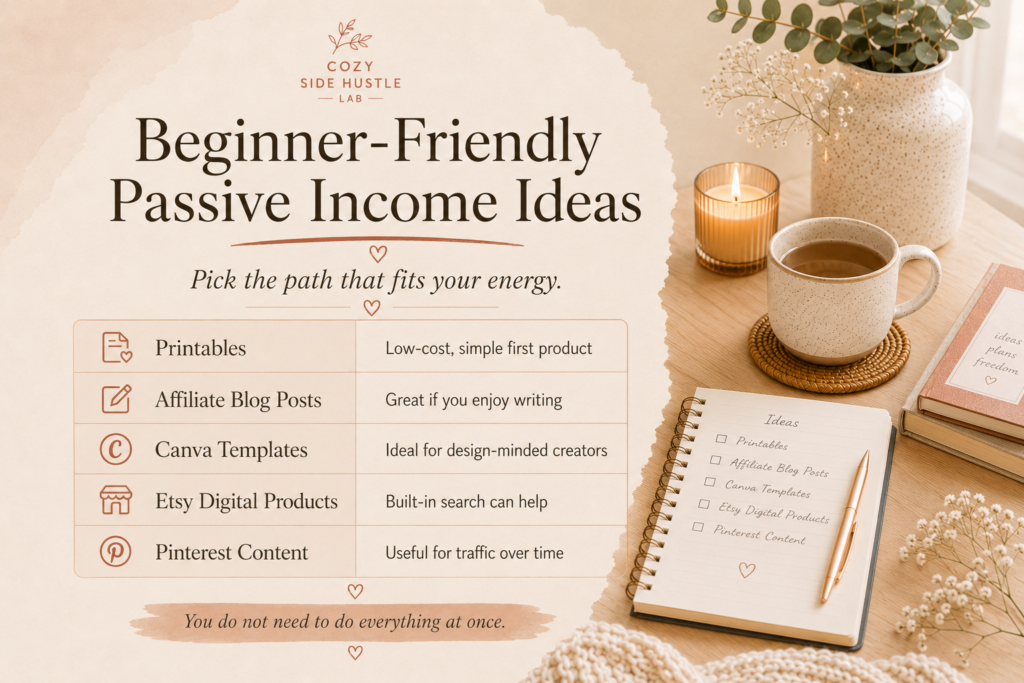
4. Printables
Printables are digital files customers download and print at home.
Examples include:
- planners;
- checklists;
- trackers;
- budget pages;
- meal planners;
- cleaning routines;
- homeschool worksheets;
- self-care pages;
- party games.
Good for:
People who enjoy Canva, planning, organizing, or creating useful resources.
Why it can work:
Printables are low-cost to create and can be sold on Etsy, your own site, or digital product platforms.
Realistic first step:
Create one simple printable that solves one small problem, such as a weekly reset checklist.
Honest note:
The printable market is competitive. Specific products for specific people usually work better than random general printables.
5. Canva templates
Canva templates are editable designs buyers can customize.
Examples include:
- Pinterest pin templates;
- Instagram templates;
- media kits;
- worksheets;
- ebooks;
- planners;
- lead magnets;
- small business graphics.
Good for:
People who enjoy design, layout, and making things easier for other creators.
Why it can work:
Many bloggers, Etsy sellers, and small business owners want polished designs without starting from scratch.
Realistic first step:
Create a pack of five templates for one specific audience.
Example: Pinterest templates for beginner bloggers.
Honest note:
Templates need to be easy to use. A pretty design that confuses buyers may lead to frustration.
6. Etsy digital products
Etsy digital products can include printables, templates, invitations, planners, spreadsheets, coloring pages, and downloadable guides.
Good for:
People who want to use a marketplace where buyers are already searching.
Why it can work:
Etsy has built-in search traffic, which can help beginners get discovered without having a large audience.
Realistic first step:
Research one product category and create one simple product with clear mockups and keywords.
Honest note:
Etsy is not automatic. Photos, titles, keywords, reviews, and product quality matter.
7. Mini ebooks or paid guides
A mini ebook is a small digital guide that helps someone solve one clear problem.
Examples:
- “A Beginner’s Guide to Creating Printables in Canva”
- “Simple Pinterest Setup for New Bloggers”
- “The Cozy Weekly Planning Guide”
- “How to Organize Your Digital Files”
- “A Gentle Start Guide for Your First Side Hustle”
Good for:
People who enjoy writing, teaching, or explaining a simple process.
Why it can work:
A mini guide can become a low-cost digital product without needing to create a full course.
Realistic first step:
Outline a guide with five to seven clear steps.
Honest note:
A guide still needs a clear audience and a way to reach buyers.
Traffic-Based Passive Income Ideas
Traffic-based income depends on people finding your content, products, or recommendations.
This is where many beginners need patience.
8. Pinterest traffic to products or blog posts
Pinterest can send traffic to blog posts, Etsy listings, freebies, affiliate content, or product pages.
It works especially well for visual and searchable topics.
Good for:
People who enjoy visuals, keywords, and quieter marketing.
Why it can work:
Pinterest users often search for ideas, solutions, and products. Pins can continue circulating after they are published.
Realistic first step:
Create five pins for one blog post, product, or freebie.
Honest note:
Pinterest is not instant. Design, keywords, consistency, and testing matter.
9. Email sequences
An email sequence is a set of emails new subscribers receive automatically after joining your list.
For example, someone downloads your free printable checklist, then receives a few helpful emails introducing them to related tips, resources, affiliate tools, or products.
Good for:
People who want to build trust without constantly posting online.
Why it can work:
An email sequence can welcome new readers and guide them toward helpful next steps.
Realistic first step:
Create one simple freebie and write three welcome emails.
Honest note:
You still need people to join your list. The sequence does not help much without subscribers.
10. Affiliate comparison posts
Affiliate comparison posts help readers choose between tools, products, or platforms.
Examples:
- “Canva Free vs Canva Pro for Printable Sellers”
- “Etsy vs Your Own Website for Digital Products”
- “Best Pinterest Tools for Beginner Bloggers”
Good for:
People who enjoy research and balanced recommendations.
Why it can work:
Readers searching for comparisons may already be close to making a decision.
Realistic first step:
Choose two tools you understand and write a fair, helpful comparison.
Honest note:
Comparison content needs honesty. Do not pretend every tool is perfect.
Low-Energy Passive Income Starting Points
If you have limited energy, start smaller than you think you should.
11. One tiny printable
Instead of creating a 50-page planner, create one helpful page.
Examples:
- a weekly reset checklist;
- a habit tracker;
- a simple meal planner;
- a budget snapshot;
- a content idea sheet.
This is a good way to practice product creation without overwhelming yourself.
12. One helpful blog post
Instead of launching a full blog strategy, write one article that solves one clear problem.
Examples:
- “How to Choose Your First Side Hustle”
- “What to Sell as a Printable Beginner”
- “How to Use Pinterest for a Small Blog”
This helps you practice content creation and SEO basics.
13. One small affiliate resource
Instead of building a full affiliate website, create one resource page or one helpful recommendation post.
Examples:
- “My Favorite Free Tools for Beginner Side Hustlers”
- “Simple Canva Tools for Printable Sellers”
- “Beginner Blogging Tools to Know About”
This can become part of a larger content system later.
14. One freebie connected to a future product
A freebie can help you start building an email list.
Examples:
- a checklist;
- a quiz;
- a mini workbook;
- a starter guide;
- a template sample.
This does not earn directly at first, but it can support future passive income ideas.
Step-by-Step Beginner Plan
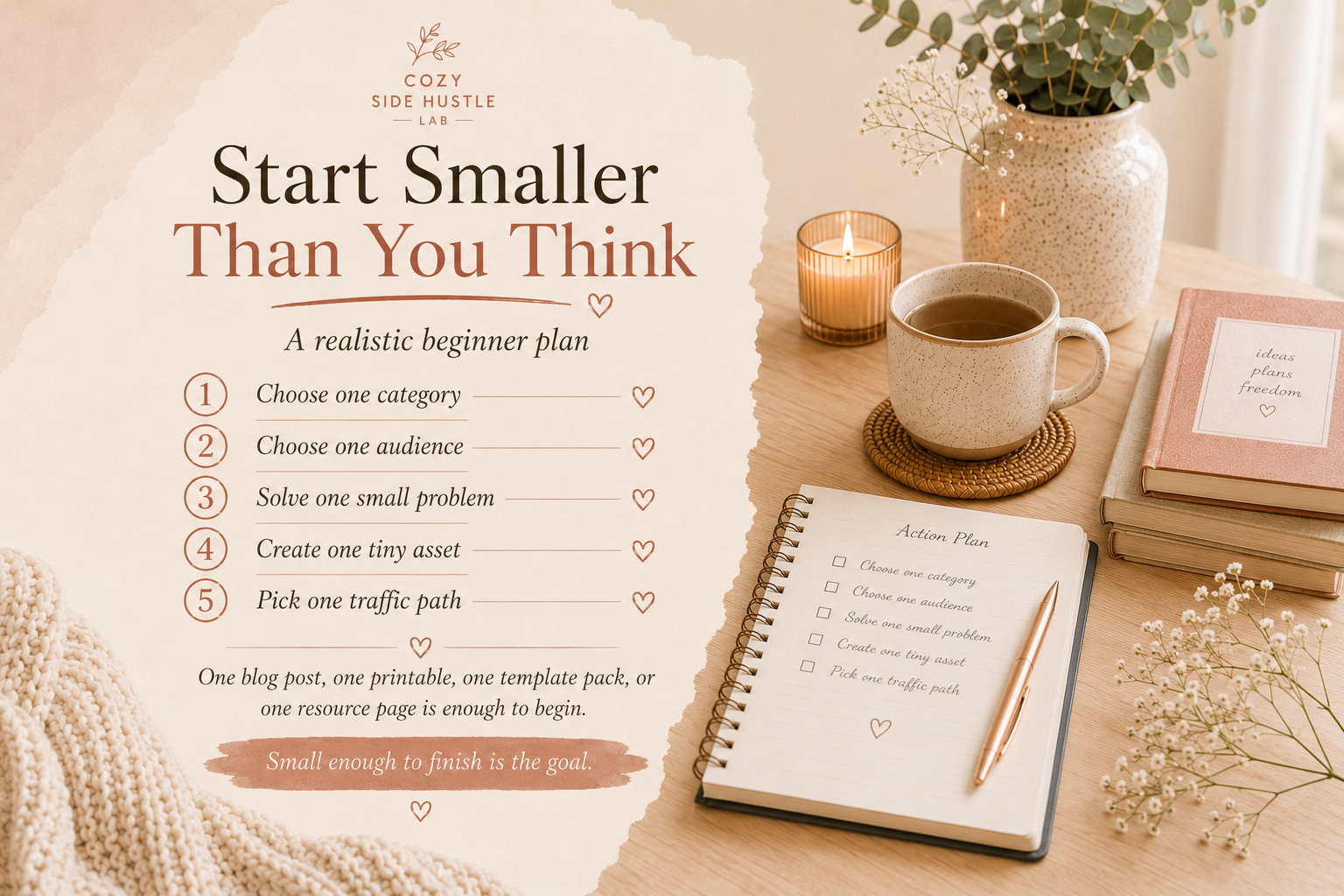
Step 1: Choose one passive income category
Start with one category:
- content-based;
- digital product-based;
- traffic-based;
- email-based;
- low-energy starting point.
Do not choose all of them.
If you enjoy writing, start with blogging or affiliate content.
If you enjoy design, start with printables or templates.
If you enjoy systems, start with planners or email sequences.
If you have very little energy, start with one tiny asset.
Step 2: Choose one specific audience
Your idea becomes easier when you know who it is for.
Instead of “I want to sell a planner,” try:
- a weekly planner for overwhelmed beginners;
- a content planner for new bloggers;
- a budget tracker for families;
- a Pinterest template pack for Etsy sellers;
- a side hustle checklist for people with limited time.
Specific is easier to create and easier to explain.
Step 3: Solve one small problem
Do not create a huge product first.
Choose one problem.
Examples:
- planning the week;
- choosing a side hustle;
- creating Pinterest pins;
- organizing blog ideas;
- tracking expenses;
- starting an Etsy shop;
- writing product descriptions.
One small problem is enough.
Step 4: Create one useful asset
Your first passive income asset could be:
- one printable;
- one template pack;
- one blog post;
- one affiliate article;
- one resource page;
- one freebie;
- one mini guide outline.
The goal is to finish something small enough to publish.
Step 5: Choose one traffic path
People need to find what you create.
Choose one main traffic path:
- Etsy search;
- Pinterest;
- Google search;
- email list;
- existing social platform;
- internal links from your blog.
At the beginning, one traffic path is enough.
Step 6: Improve after publishing
After your asset is live, look for small signals.
Ask:
- Are people clicking?
- Are people viewing the product?
- Are they saving the pin?
- Are they reading the post?
- Are they joining the list?
- Are the keywords clear?
- Is the offer easy to understand?
Use what you learn to improve the asset.
Step 7: Add one related asset
Once your first asset exists, create one related piece.
For example:
- a weekly reset checklist can lead to a planner bundle;
- a blog post can lead to an affiliate resource page;
- a Pinterest template pack can lead to a larger template shop;
- a freebie can lead to a small paid guide.
This is how passive income becomes a system over time.
One small piece at a time.
A Realistic Example
Let’s imagine Lena.
Lena wants to build a passive income stream, but she only has three hours per week. She is introverted, creative, and easily overwhelmed by complicated business advice.
She likes Canva and planning, so she decides to start with printables.
At first, she wants to create a full life planner with 60 pages. But when she looks at her actual energy, she realizes that is too much.
So she starts smaller.
Her first product is a simple three-page “Sunday Reset Printable.”
It includes:
- a weekly overview;
- a simple cleaning reset;
- a top priorities page.
She lists it on Etsy and creates five Pinterest pins that link to the listing.
She uses AI to brainstorm title ideas and product description angles, but she edits everything herself. She wants the product to feel warm, useful, and specific — not generic.
The first month is quiet.
She gets some views, a few favorites, and no dramatic results. Instead of quitting, she improves the mockup, rewrites the title, and creates one related freebie for an email list.
Her next product is a meal planning page that matches the Sunday Reset Printable.
Over time, Lena is not building a huge business overnight. But she is building a tiny product system around one clear audience.
That is a realistic passive income beginning.
Not effortless. Not instant. But calm, focused, and possible to grow.
Common Beginner Mistakes
Mistake 1: Believing passive means no work
This happens because passive income is often marketed as easy.
But most passive income requires upfront work and ongoing maintenance.
What to do instead:
Think of it as asset-based income. You are building something that may work over time, not avoiding work completely.
Mistake 2: Creating a product before thinking about traffic
A product needs a way to be found.
If you create a printable but do not use Etsy search, Pinterest, blogging, social content, or an email list, it may sit unnoticed.
What to do instead:
Choose one traffic path before or while creating your product.
Mistake 3: Starting too big
Beginners often try to create a huge planner, full course, large website, or complete product shop immediately.
That can lead to overwhelm and unfinished projects.
What to do instead:
Create one tiny useful asset first.
Mistake 4: Choosing a niche that is too broad
A broad idea like “planners” or “online business” can be hard to position.
Specificity makes it easier for people to understand your offer.
What to do instead:
Choose a specific audience and problem, such as “weekly planning printables for overwhelmed beginners.”
Mistake 5: Expecting results too quickly
Passive income often takes longer than people expect.
One product or one blog post rarely changes everything.
What to do instead:
Give yourself a learning phase. Track small signals like clicks, saves, views, and email signups.
Mistake 6: Using AI without adding your own judgment
AI can help with brainstorming, outlines, and drafts. But generic AI content or products are unlikely to stand out.
What to do instead:
Use AI as a support tool, then add your own experience, taste, examples, edits, and clarity.
Mistake 7: Never improving what you publish
Some beginners publish something once and assume the work is done.
But passive income assets often need refinement.
What to do instead:
Improve titles, mockups, keywords, product descriptions, pins, internal links, and calls to action over time.
What to Do Today
Set a timer for 20 minutes.
Choose one passive income idea that fits your current energy.
Then write down:
- Who is this for?
- What small problem does it solve?
- What is the tiniest useful version I could create?
- How would someone find it?
For example:
“I will create a one-page weekly reset printable for overwhelmed beginners and list it on Etsy. I will make five Pinterest pins to test traffic.”
Or:
“I will write one blog post about beginner Canva tools and include one honest affiliate recommendation.”
That is enough for today.
You do not need a full passive income system yet.
You need one small asset you can actually finish.
FAQ
What are realistic passive income ideas for beginners?
Realistic passive income ideas for beginners include printables, Canva templates, affiliate blog posts, niche websites, Etsy digital products, resource pages, Pinterest traffic, email sequences, and mini ebooks. These usually require upfront work and ongoing improvement.
Is passive income actually passive?
Passive income is rarely fully passive, especially at the beginning. Most passive income streams require setup, creation, traffic, testing, and maintenance. A more realistic term is semi-passive or asset-based income.
What is the easiest passive income idea to start?
One of the easiest starting points is a small digital product, such as a printable checklist, Canva template, or simple planner page. Another beginner-friendly option is one helpful affiliate blog post if you enjoy writing.
How long does passive income take to work?
It depends on the idea, traffic source, niche, product quality, and consistency. Some ideas may get small signals quickly, while others take months to grow. Beginners should expect a learning phase instead of instant income.
Can I build passive income with no audience?
Yes, but you need a discovery path. If you do not have an audience, you can use Etsy search, Pinterest, Google search, SEO blog posts, or niche websites to help people find your content or products.
Is affiliate marketing passive income?
Affiliate marketing can become semi-passive if you create helpful content that continues to attract readers. However, it still requires traffic, trust, updates, and honest recommendations.
Can AI help me build passive income?
AI can help you brainstorm ideas, outline blog posts, draft product descriptions, create Pinterest title options, and organize your content plan. But AI should support your ideas, judgment, experience, and voice — not replace them.
Conclusion
Passive income can be real, but it is often misunderstood.
For beginners, the most realistic version is not “do nothing and get paid.”
It is creating small, useful assets that may continue to work over time.
A printable.
A blog post.
A template.
A resource page.
An affiliate guide.
A Pinterest pin.
A simple email sequence.
You do not need to do everything at once. You do not need to create a giant product library. You do not need a loud personal brand or endless energy to begin.
Start with one small asset.
Learn from it.
Improve it.
Then add the next piece.
A calm side hustle should support your life, not consume it. And passive income, when approached realistically, can be one gentle part of that bigger picture.
Call to Action
Want help choosing your first calm and realistic side hustle? Join the Cozy Side Hustle Lab list for beginner-friendly ideas, simple tools, and gentle next steps as they become available. You can also save this guide for later when you are ready to choose your first tiny step.